This scale is perhaps less familiar to most guitarists than the minor pentatonic, but it is equally useful. You hear this sound all the time in just about every style of music – rock, blues, country, jazz, you name it…
Here’s a video taking you through some major pentatonic essentials, and I develop these ideas in a bit more depth explanation underneath.
A little bit of theory…
Perhaps the best way of looking at this scale is to see it as a subset of the major scale. If you take the first, second, third, fifth and sixth notes of any major scale, you have a major pentatonic scale. In the key of C it works like this:
C Major Scale: C D E F G A B
C Major Pentatonic Scale: C D E G A
We can talk about the formula for the major pentatonic scale as being 1 2 3 5 6. Grab those notes from any major scale and you have the major pentatonic in the same key. So for the key of A we have:
A Major Scale: A B C# D E F# G#
A Major Pentatonic Scale: A B C# E F#
2 Must-Know Shapes
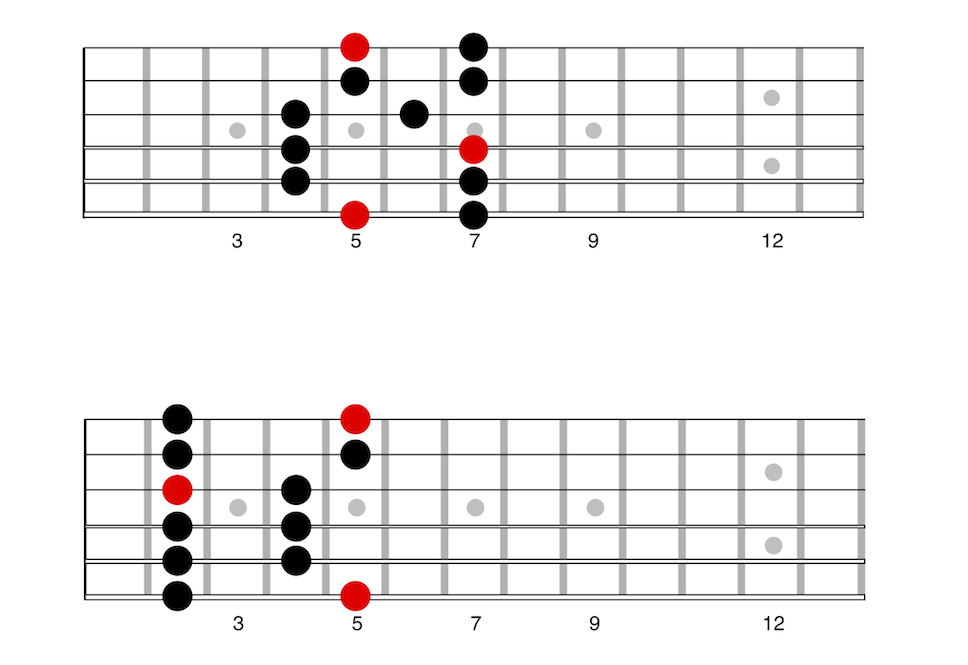
Now you’ll want to get these 2 shapes under your fingers right away. Both are super-common, and super-useful. Check out the video for suggestions on fingering. I’ve written them out in the key of A but they of course work in any key. Just shift the pattern up or down the neck until those red root notes correspond to the root of the key you want to play in. But dude, these look just like frickin’ minor pentatonic scales?!! Read on below…
Relative major and minor pentatonic scales explained
It is a source of great confusion for many a beginner (and intermediate for that matter) guitarist that the scale shapes for the major and minor pentatonic scales are exactly the same. So what’s going on there? Every major scale has what is known as its relative minor scale; a scale which contains exactly the same notes but starting from a different point. It’s exactly the same with pentatonic scales. Look at this:
A Minor Pentatonic Scale: A C D E G
C Major Pentatonic Scale: C D E G A
The A minor pentatonic scale contains exactly the same notes as the C major pentatonic, we’re just starting from a different place. And this works for every other key too. Worth remembering:
- The 6th note of any major scale is the root of the relative minor scale
- The 3rd note of any minor scale is the root of the relative major scale
- The 5th note of any major pentatonic scale is the root of the relative minor pentatonic scale
- The 2nd note of any minor pentatonic scale is the root of the relative major pentatonic scale.
The 3 frets down trick
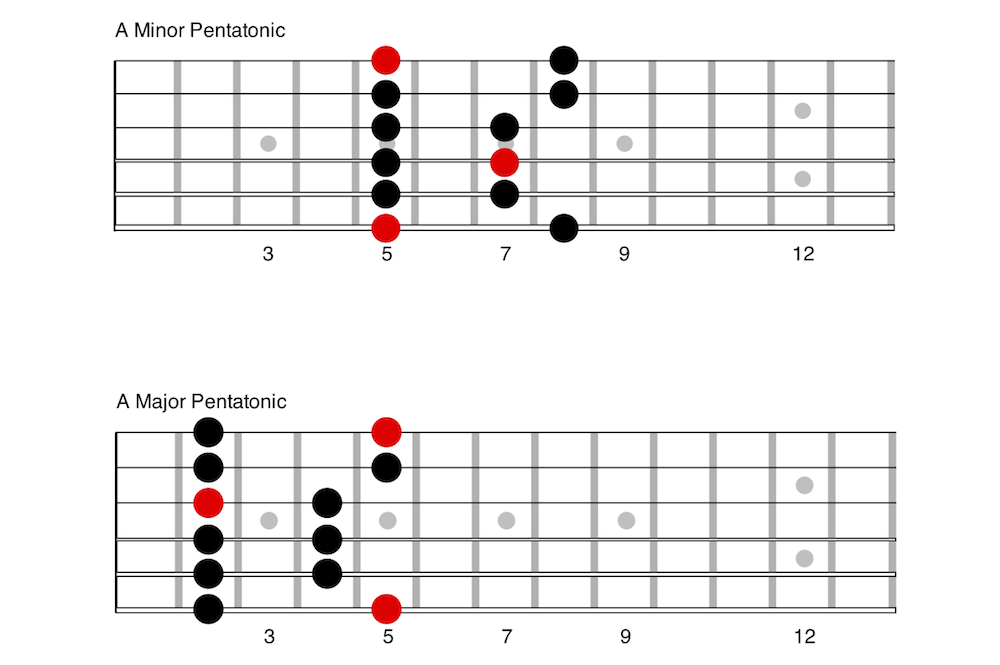
Since most players are far more familiar with the minor pentatonic scale shapes, this is an easy cheat for getting the major pentatonic notes under your fingers. Simply move the minor pentatonic scale 3 frets down and you’ll be playing the notes from the major pentatonic scale in the same key. So you can move your familiar A minor pentatonic shape at the 5th fret down to the 2nd fret and you’ll be playing A major pentatonic. Like so…
So why bother learning my major pentatonics when I already know my minors?
The key point to grasp is this: although the fretboard patterns are the same the root notes are in different places in each scale. When playing an A minor Pentatonic scale the note A is the root, home base, the note we tend to emphasise when we’re soloing. When playing C major pentatonic, the C note is now ‘home’. Hence each scale has a very different character. This is why it’s so important on the guitar to be aware of where your root notes are, so you’re able to bring out the sound of each scale effectively. Check out the example below. On my scale diagrams root notes are marked in red. Notice that although each fingering pattern is exactly the same, those red dots are in different places. In the long run I strongly recommend you learn you major and minor pentatonic shapes as 2 separate scales, practising them starting and finishing on the correct root note. That way you’ll instantly be able to find and use the scale in a musical way. In the beginning it is of course totally acceptable to derive your major pentatonic scales from the already familiar minor pentatonic shapes, but that will only get you so far.

All 5 Patterns of the Major Pentatonic Scale
When you’re ready you can try learning all 5 patterns of the scale, which taken together allow you to use the major pentatonic sound all over the fretboard. Once again, I stress the importance of learning these as scales in their own right. Just because you know your minor pentatonic shapes doesn’t necessarily mean you know these scales. Practice them with an awareness of the function of the notes, noting particularly where those root notes fall. I will generally practice scales starting and finishing on the lowest available root note in any given position. I’ve written the shapes out below with a few comments on each of them. I like to number them 1-5, with Pattern 1 being probably the most commonly used pattern with the root on the 6th string.
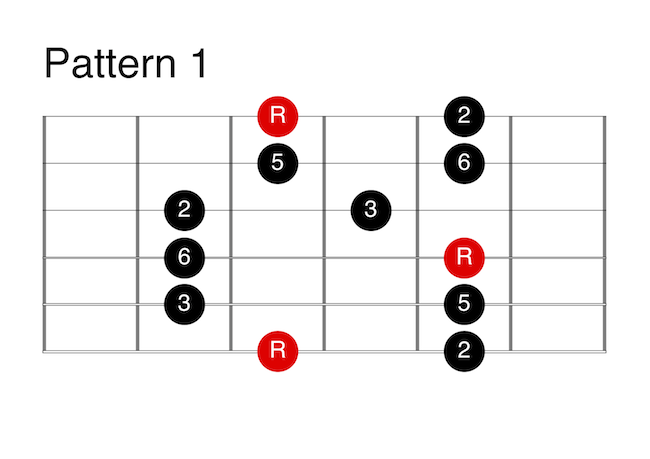 In CAGED terms this is the E form, meaning it relates to an E shape major barre chord. The red dots are the roots, and the numbers relate to the intervals of the notes in the scale in relation to the root. More advanced players should try and be aware of these functions, as you’ll have a deeper understanding of the scale and won’t simply be running up and down a finger pattern.
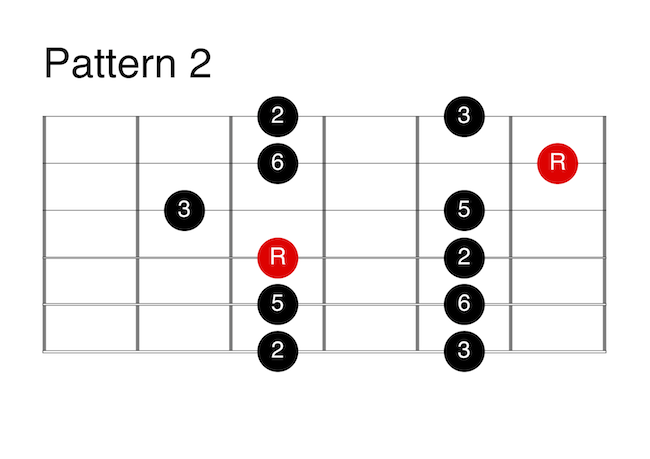 The D form of the scale. Can use finger 1 and 3 for all of it, or switch to 1 and 4 on the G and B strings if you prefer.
 The C form of the scale. Some great country licks in and around this shape.
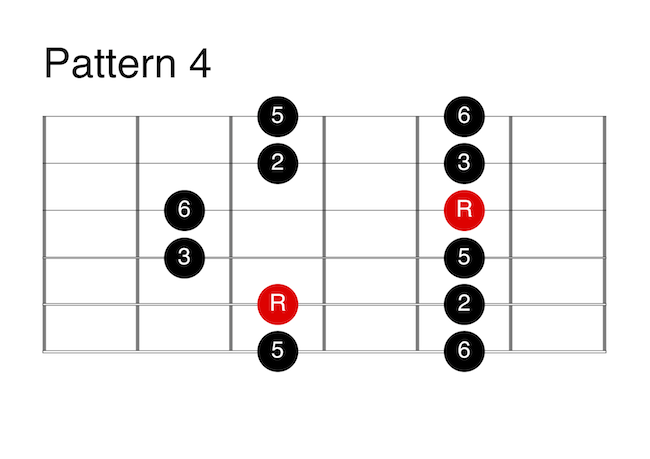 The A form. Fingers 1 and 3 all the way, or switch to 1 and 4 on the middle 2 strings.
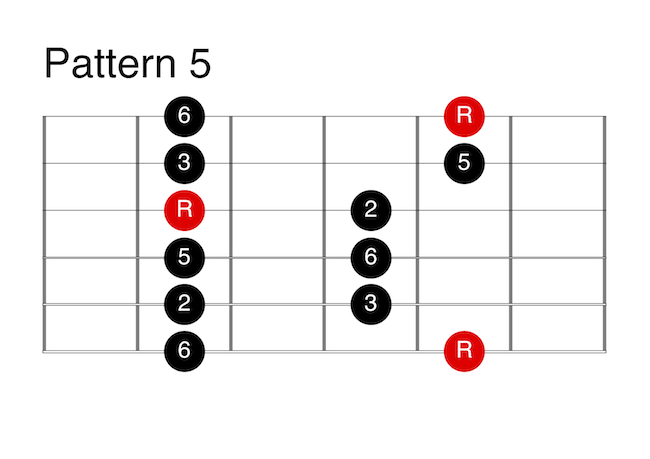 Probably the most familiar shape to many of you since it’s the most common minor pentatonic finger pattern. The root notes are in a different place when we’re using it as a major pentatonic though.
Using the Major Pentatonic Scale
Coming soon…
Major Pentatonic Examples
There are tons of these, but here are a few of the songs on my site which are good examples of this scale being used in a real musical situation.
James Burton’s solo on the Rick Nelson song It’s up to You relies heavily on the D major pentatonic scale. Check out the lesson here.
James Honeyman-Scott is using the E major pentatonic scale for his classic solo on the song Kid. Check out the lesson here.
The intro solo on the Only Ones classic another Girl Another Planet also uses the E major and major pentatonic scales. Check it out here.