• Skip to primary navigation
  • Skip to main content
  • Home
  • Songs
  • Courses
  • Lessons
    • Beginners start here
    • Blues
    • Country
    • Chords
    • Licks & Solos
    • Resources
  • Patreon
  • Music

Anyone Can Play Guitar

Online and private guitar tuition

Donate

Improver

Joy To The World

11th January 2017 by adambradford

by John Fahey

My version is based on the recording found on Fahey’s album The New Possibility: John Fahey’s Guitar Soli Christmas Album. I think this was the first recording he made of the piece, and he recorded it again several times over the years in slightly different arrangements. My transcription can be found below. I’ve tried to stay quite faithful to the original recording but in some instances I’ve slightly smoothed out some of the idiosyncrasies to make a readable, playable version. I’ve not written out the second verse in full as it’s more or less the same as the first with a few minor rhythmic variations. Be sure to play four steady thumb notes per bar, as this holds everything together.

I’m playing the melody notes mainly with my index and middle fingers, occasionally using my 3rd finger, but exactly how you do it is up to you. It sounds like Fahey is sometimes using his index finger to brush upwards and hit two strings at once and I’ve added these notes in brackets, for you to include if you want to. It’s very hard – for me, at least –  to reproduce Fahey’s technique exactly, so take this as a guide and don’t be afraid to do it your own way. It should all come together quite quickly if you’ve played pieces in this style before. If you’re new to fingerstyle guitar you might need to take it bar by bar, working on the coordination between thumb and fingers and paying attention to whether each melody note coincides with or falls between the bass notes. Feel free to simplify things, and concentrate on just the bass line and a single note melody line.

Here is the only video footage I could find of Fahey playing this piece. He’s not quite playing the piece in the same way as the original recording, but it’s an interesting watch, and useful to check out his right hand technique and to see which chord shapes he uses.

Filed Under: Improver

Teenage Kicks

11th January 2017 by adambradford

by The Undertones

In this lesson I look at the iconic punk-pop song Teenage Kicks. It’s quite easy to play, and a great one to learn if you’re just starting to get into barre chords and power chords. As usual, I take you through the basics before looking in a bit more detail at the finer points of the song, for those of you who want to play it just like the record. On the original, there are at least two guitars, which are essentially playing the same thing, but with minor differences in feel. I tend to play the song with a loose down-up strum in my picking hand, but it would probably work just as well with an aggressive all downstroke kind of approach. Feel free to experiment.

Below is a basic outline of the chords. To me, it sounds like all the chords are played as 6th string root barre or power chords. If you’re not familiar with these chord shapes you might like to check out a couple of basic barre chord lessons elsewhere on this site. Use the rhythm here as a guide as it varies a little bit throughout the song.


And here are the instrumental sections:


Filed Under: Improver

In A Gadda Da Vida

11th January 2017 by adambradford

by Iron Butterfly

In this lesson I’m looking at a psychedelic rock classic from Iron Butterfly. Guitar on the original version was I think played by Erik Brann who was only 17 when he recorded it. But over the years the band went through a comically convoluted series of line-up changes, including over a dozen guitarists. (Just look at their Wikipedia page for a nerdy colour-coded bar graph of the myriad different members.) The original song is over 15 minutes long, taking up the entire second side of their In-A-Gadda-Da-Vida -Album, but I’m just concentrating on the main riff, which has long been a favourite of mine. It’s reasonably easy to play, and I’ve not much to add to what I say in the video here. It’s possible to play the riff in 3 or 4 different places on the neck, but I’m going with what feels and sounds right to my ears. There’s not much clear video footage of Brann himself playing it, so it’s hard to be 100% certain. I’ll leave the fingering up to you; I think I play everything with fingers 1, 2 and 3. There’s nothing particularly fast or technical here, so it can probably be played with mostly down strokes in the picking hand.

Getting The Sound

Much of the greatness of this riff resides in its guitar sound which is a raw, garage-y 60s fuzz tone. Any nasty sounding fuzz or distortion box should get you close but a Mosrite Fuzzrite was used on the original – a classic pedal also used by Johnny Ramone and Ron Asheton of The Stooges as well as being responsible for sounds heard on Ennio Morricone spaghetti western soundtracks. I’d love to have one, but they’re not cheap, and quite hard to come by these days. For this video I’m making do with a software version found inside Amplitube – obviously nowhere near as cool as the original, but still a useable sound. A few pedal makers seem to be making Fuzzrite copies these days which I might have to investigate.

I’ve tabbed out the various different riffs below. Download PDF here.


Filed Under: Improver

Pictures Of Matchstick Men

11th January 2017 by adambradford

by Status Quo

Before they morphed into denim-clad boogiemeisters Status Quo were a late 60s psychedelic pop band, and this track is their most famous from that period. It’s a great song with a great riff, and it’s really easy to play. There seem to be at least a couple of different versions or mixes, and I prefer the one below which has the extra wah-wah guitar part and an overall more psychedelic sound.

Here’s some decent footage of The Quo playing the song. At the start of the clip you get a good view of Francis Rossi playing the main riff: all on the B string with downstrokes of the pick throughout. You also get to see how Rossi and Parfitt are playing the chords in different areas of the neck.

I’ve written out the main riff below:


And here’s a simple chord/lyric sheet for the entire song outlining the basic harmony. It’s up to you where you play the chords – probably best to just experiment and see what works best for you. If you’re a beginner, then most of it can be played with open chords in the first position and an easy F chord. If you know your barre chords, then there are plenty of options further up the neck. Download a PDF here should you wish.


Getting The Sound

As I say in the video, I’m not exactly sure what effects were used to get the guitar sound on the original – whether it’s an effects pedal or a tape-based studio technique. Maybe it’s both, as at certain points the effect is just on the guitar and at other times across the entire mix of the track. It sounds to me like some kind of phaser or flanger effect, and the entire guitar part could be double-tracked in places too. You can get quite close by using any phaser or flanger pedal and setting the rate or speed control quite slow.

If anyone knows exactly how the sound was acheived I’d really like to know, as there seems to be no definite information on the internet.

Filed Under: Improver

Iron Man by Black Sabbath

11th January 2017 by adambradford

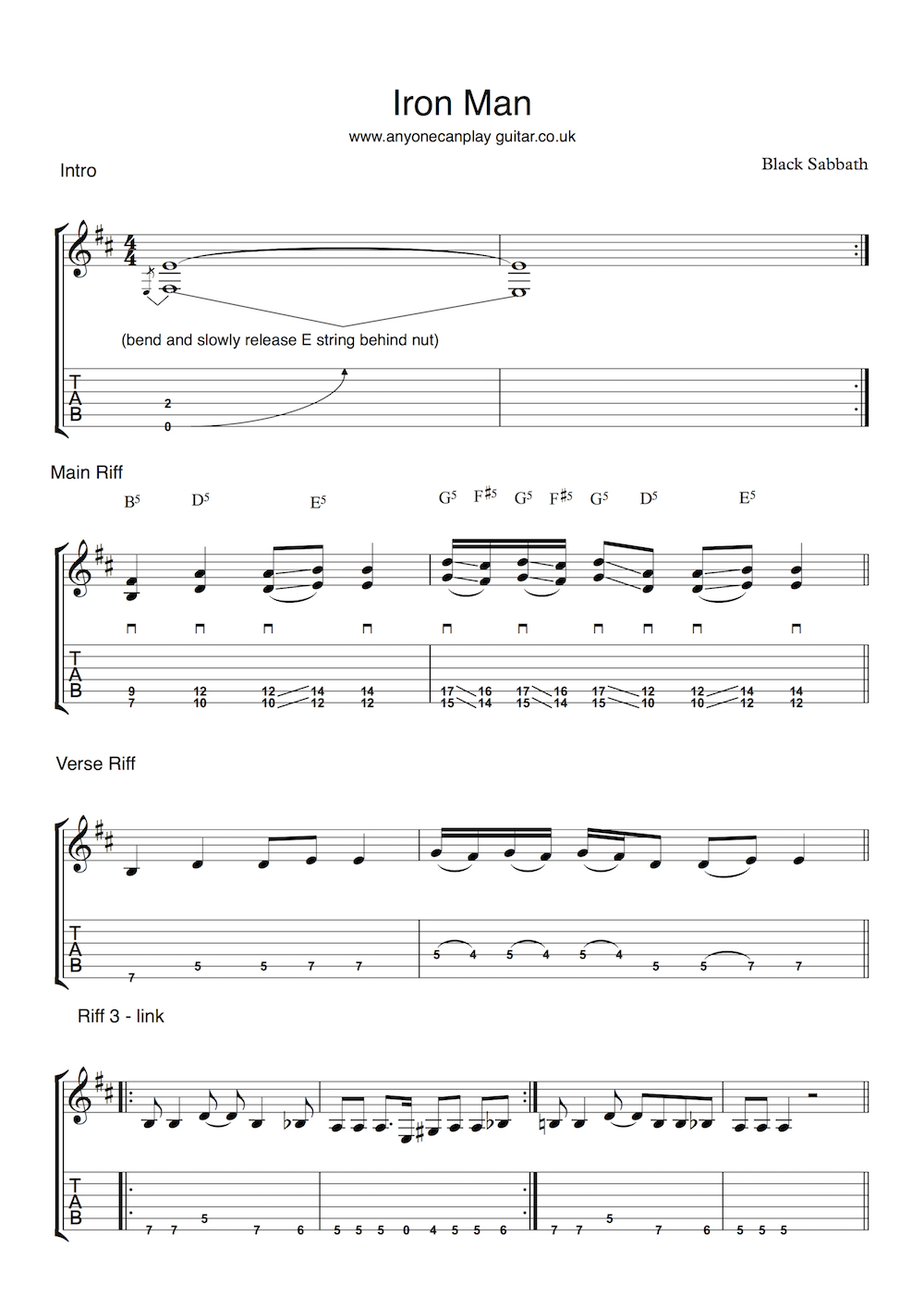
In this lesson I look at one of rock’s greatest riffs. For such a well-known riff it’s amazing how many people don’t get it quite right. The way I play it is based on the version found on Sabbath’s second album Paranoid. There also seem to be a couple of other later re-recordings of the song which are nowhere near as good as the original.

On YouTube is some great footage of Iommi himself talking about the song and demonstrating the riff. He also clears up the controversy over exactly how he plays the introduction. (Or so I thought, until I came across some live footage from the 70s where he doesn’t appear to be bending behind the nut at all but is perhaps bending the open E string by pushing down on the tailpiece of his SG with his picking hand. In more recent live versions he’s definitely using the behind the nut bending technique, but maybe that’s because he no longer uses an SG with a floating tailpiece. As to which method he uses on the original recording I can’t be 100% sure, but the nerd in me would really like to find out.)

As promised, I’ve written out the main riff, along with the other riffs in the song. Notice how during the verse Iommi plays the main riff slightly differently using single notes a bit lower down the neck. I haven’t written out the solo as it would have taken me bloody ages. If you’ve played a bit of lead guitar before though, it shouldn’t be too hard to work out yourself what’s going on. The first solo mainly uses the C# Minor pentatonic scale in the 9th position. And at the end there is some more soloing using the B minor pentatonic scale. Download a high-quality PDF of the tab here.

Filed Under: Improver, Intermediate Tagged With: Metal, Rock

Terrapin by Syd Barrett

11th January 2017 by adambradford

by Syd Barrett

A lovely, easy to play tune by one of my favourite songwriters. I show you 3 ways to approach it: simple strumming, electric guitar arpeggios, and a cool way of combining the chords and melody at the same time.

In case you don’t already know it, the original recording sounds like this:

And here’s my video lesson:

You might also want to check out this live clip of David Gilmour playing the song, elaborating the basic chords with some nice melody notes:

 Simple Strumming

This approach is based on the acoustic part Syd plays on the original recording. The chords used are mostly 6th string root barre chords, but there’s also an open E, a 5th string root D barre chord, and a nice E7 chord in the ‘C form’. I’ve written out the chords below. Make sure you locate the barre chords at the right fret – I’ve put fret numbers alongside. If we’re going to get nerdy about it, you can’t always hear the low root note of the barre chords on the recording. It could be that Syd mostly fretted his barre chords in the kind of folky fashion where he was just covering the top two strings with his index finger and not barring all the way across. Either way works – it’s up to you. If you need a bit more help with the technique and theory behind barre chords you might like to look at these lessons where I take you through the basics:

All About Barre Chords, Part 1

All About Barre Chords, Part 2


I’ve written out a chord/lyric chart to the song below. I thought this was the most straightforward way of writing out this song. It should be quite easy to piece the whole tune together, but you’ll need to watch my video and listen closely to the original to get all the rhythmic details correct.


You can download a high-quality PDF of the music here.

Arpeggios

Below I’ve written out a verse and B-section’s worth of the overdubbed electric part. It sticks fairly closely to what Syd plays during the first verse and first B-section. I’d suggest using this as a guide and improvising your own part based on the underlying chords.


Chords With Added Melody Notes

This is just a question of adding a few melodic ornamentations to the basic chords. Mostly this is done with the pinky, meaning you’ll need to re-finger your barre chords to free the little finger up. Watch the video to see me demonstrate one way of doing this. When I get time I might write out some tab/music for this approach too.

Filed Under: Improver Tagged With: Acoustic, Alternative, Pop

  • « Go to Previous Page
  • Page 1
  • Interim pages omitted …
  • Page 10
  • Page 11
  • Page 12
  • Page 13
  • Page 14
  • Go to Next Page »

Footer Widget Header

Sign up for my monthly newsletter:
  • Home
  • Songs
  • Courses
  • Music
  • Patreon
  • Beginners
  • Blues
  • Country
  • Chords
  • Licks & Solos
  • Resources
  • About
  • Contact
  • Privacy policy
  • Cookie policy

Copyright © 2026 · Anyone Can Play Guitar

  • Home
  • Songs
  • Courses
  • Lessons
    ▼
    • Beginners start here
    • Blues
    • Chords
    • Country
    • Licks & Solos
    • Resources
  • Patreon
  • Music
  • Facebook
  • YouTube
  • Privacy policy
  • Cookie policy