• Skip to primary navigation
  • Skip to main content
  • Home
  • Songs
  • Courses
  • Lessons
    • Beginners start here
    • Blues
    • Country
    • Chords
    • Licks & Solos
    • Resources
  • Patreon
  • Music

Anyone Can Play Guitar

Online and private guitar tuition

Donate

Power Chords

Chinese Rocks by The Heartbreakers/Johnny Thunders

11th January 2017 by adambradford

This one is an absolute punk classic and, from a guitar point of view, it’s pretty easy to play. I’ve written out the music for the main parts of the song below. Rather than  do a note-for-note transcription of both guitar parts (which would have taken me ages to write out, and would probably be a bit unnecessary) I’ve written out the main parts of the song and a few of the added lead licks and fills. If you want to get nerdy, I suggest listening closely to the original recording: you should be able to figure out any of the other little variations which I didn’t go into in the video. If you’re a beginner I recommend getting the basic riffs and chords together first. Once, you’re comfortable with that you can try adding in a few of those extra flourishes.

Filed Under: Improver Tagged With: Alternative, Punk, Rock

Sweet Home Chicago by Magic Sam

11th January 2017 by adambradford

You might not be familiar with the name Magic Sam but the chances are you’ve heard this song before. Robert Johnson recorded a beautiful acoustic version of the track in the 1930s and the song was further popularised when it was featured in the film The Blues Brothers (it’s actually dedicated to Magic Sam in the film and on the soundtrack album). One way or another it’s a tune every blues guitarist should be familiar with. The arrangement found in this lesson is essentially a direct transcription of the track found on Sam’s album West Side Soul. I’ve made a couple of tiny changes here and there to clarify things which are a bit ambiguous on the original. I’ve also combined the rhythm and lead guitar parts, which sound like they’re played by two different players on the original. You can either play it as written or get someone else to back you up on rhythm guitar while you concentrate on the lead.

Find the transcription below. Probably the hardest thing is getting all the rhythms correct. I suggest taking it phrase by phrase: listen closely to the original, and pay close attention to the rhythmic notation above the tab, counting your way slowly through the more tricky passages. (Can’t read rhythmic notation? I highly recommend you get into this as it’s a super-useful skill to have which will make you a much better musician and player.)

I’m not going to go into a full analysis of the piece right now, but one of the things I like is the way Sam is really bringing out the flavour of each of the chords in his lead licks. Rather than just playing one scale throughout, he’s often emphasising notes from the chord he happens to be on at the time. Something to think about next time you’re improvising on a blues.

I’ll leave the right hand picking up to you. From the footage I’ve seen I think Sam himself played with his right-hand fingers. I’m mainly using a pick: all downstrokes for a nice aggressive feel on the opening riffs, a combination of up and downstrokes for the more complex single note lines, and the occasional note played with the middle finger of my picking hand. Experiment and find what works best for you. If you’d like a high-quality PDF of my transcription, download it here.


Filed Under: Intermediate Tagged With: Blues

Shot by Both Sides by Magazine

11th January 2017 by adambradford

This is what the album recording sounds like:

And this is the original single version:

It’s interesting to compare the two recordings. I think both of them are great in different ways, so it’s hard to say which I prefer. The single feels like more of a traditional punk recording: raw and to the point, power chords, no keyboards. The version on Real Life is more produced (with John Leckie twiddling the knobs, as he did years later for Magazine-lovers Radiohead on their album The Bends), the guitars are a bit more layered and jangly, and there are interesting keyboard textures from Dave Formula, who I don’t think was a member of the band at the time of the single recording.

I’ve written all the music out below. I’ve just given you the various parts for the different sections – listen to the recording and it should be easy enough to put everything together in the right structure. As I talk about in the video, there are some – mostly minor differences between the guitar parts on the two different recordings. The rhythm guitars on the single are all power chords – so just leave out the top 2 or 3 notes in the barre chords if you want to take this approach. The main riff is played exactly the same on each recording. The solo I’ve written out is the album version though the single version is very similar.


On a side note, I’ve become increasingly irritated with Sibelius, the software that I use to notate all my music. Maybe it’s great if you’re composing a symphony or scoring multiple parts for some complex ensemble but for anything beyond the most basic guitar-based notation it’s a right pain in the arse. Things which should be simple like unison bends or slides into or off of notes require much time-consuming faffing. The key signature is ignored when you’re pasting notes from the tab and you have to go in and manually fix all the notes. And you may as well forget about complex bending stuff like you find in country guitar solos. I’ve only stuck with it as it’s supposedly the most ‘pro’ and sophisticated notation software available. Think I’ll give Guitar Pro another try. [End of rant.]

Filed Under: Intermediate Tagged With: Alternative, Post-Punk

Iron Man by Black Sabbath

11th January 2017 by adambradford

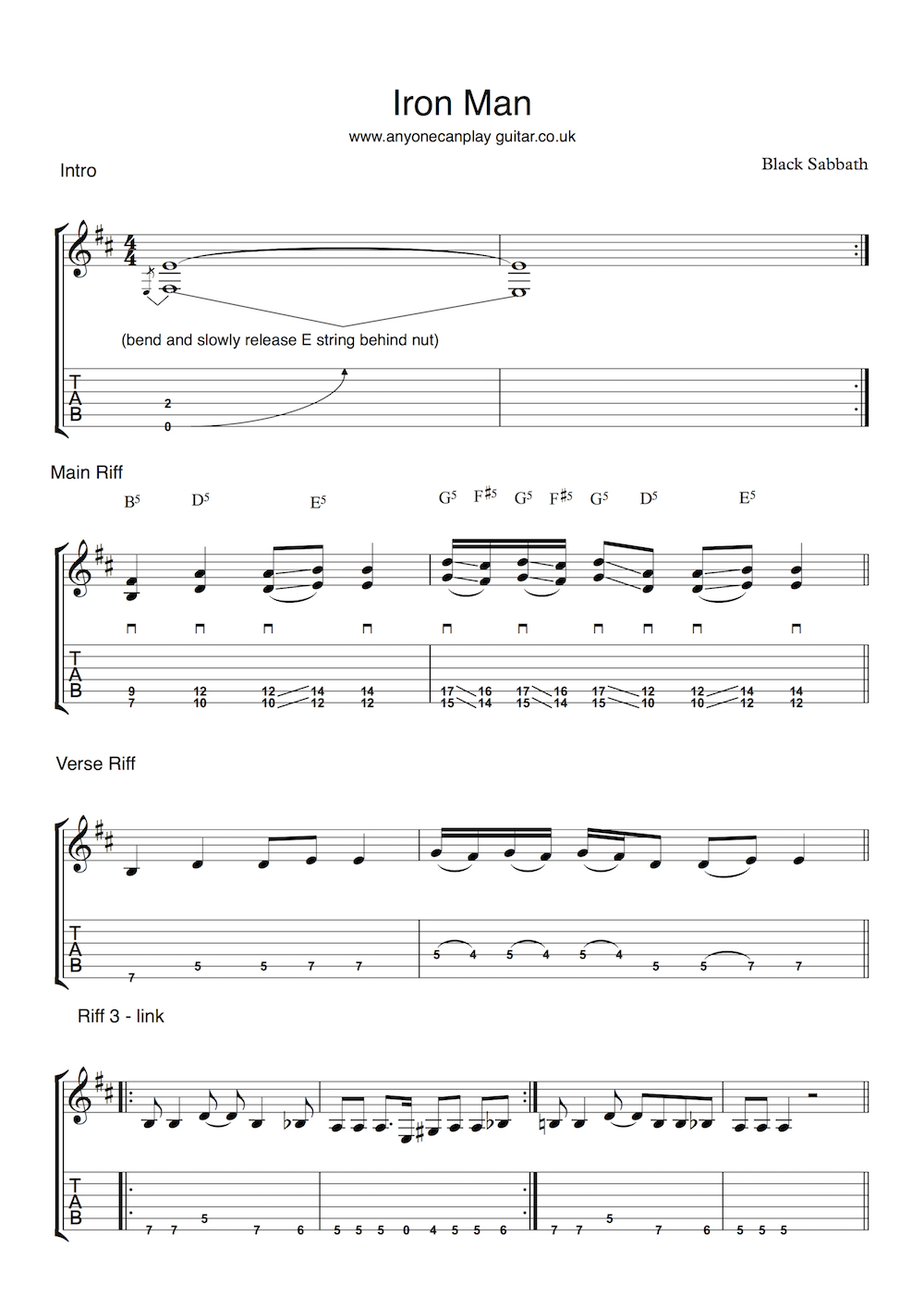
In this lesson I look at one of rock’s greatest riffs. For such a well-known riff it’s amazing how many people don’t get it quite right. The way I play it is based on the version found on Sabbath’s second album Paranoid. There also seem to be a couple of other later re-recordings of the song which are nowhere near as good as the original.

On YouTube is some great footage of Iommi himself talking about the song and demonstrating the riff. He also clears up the controversy over exactly how he plays the introduction. (Or so I thought, until I came across some live footage from the 70s where he doesn’t appear to be bending behind the nut at all but is perhaps bending the open E string by pushing down on the tailpiece of his SG with his picking hand. In more recent live versions he’s definitely using the behind the nut bending technique, but maybe that’s because he no longer uses an SG with a floating tailpiece. As to which method he uses on the original recording I can’t be 100% sure, but the nerd in me would really like to find out.)

As promised, I’ve written out the main riff, along with the other riffs in the song. Notice how during the verse Iommi plays the main riff slightly differently using single notes a bit lower down the neck. I haven’t written out the solo as it would have taken me bloody ages. If you’ve played a bit of lead guitar before though, it shouldn’t be too hard to work out yourself what’s going on. The first solo mainly uses the C# Minor pentatonic scale in the 9th position. And at the end there is some more soloing using the B minor pentatonic scale. Download a high-quality PDF of the tab here.

Filed Under: Improver, Intermediate Tagged With: Metal, Rock

  • « Go to Previous Page
  • Page 1
  • Page 2
  • Page 3
  • Page 4

Footer Widget Header

Sign up for my monthly newsletter:
  • Home
  • Songs
  • Courses
  • Music
  • Patreon
  • Beginners
  • Blues
  • Country
  • Chords
  • Licks & Solos
  • Resources
  • About
  • Contact
  • Privacy policy
  • Cookie policy

Copyright © 2026 · Anyone Can Play Guitar

  • Home
  • Songs
  • Courses
  • Lessons
    ▼
    • Beginners start here
    • Blues
    • Chords
    • Country
    • Licks & Solos
    • Resources
  • Patreon
  • Music
  • Facebook
  • YouTube
  • Privacy policy
  • Cookie policy