• Skip to primary navigation
  • Skip to main content
  • Home
  • Songs
  • Courses
  • Lessons
    • Beginners start here
    • Blues
    • Country
    • Chords
    • Licks & Solos
    • Resources
  • Patreon
  • Music

Anyone Can Play Guitar

Online and private guitar tuition

Donate

Arpeggio Picking

The Headmaster Ritual by The Smiths

15th October 2017 by Adrian Woodward

I’m returning to Johnny Marr with this look at one of my favourite Smiths tracks.


The original recording sounds like this. As you can hear, there’s quite a lot going on guitar-wise – multiple electric and acoustic layers – so for my version I’ve attempted to boil all this down to a single guitar part.


And towards the end of this video we have some great footage of Marr playing some bits of the song:


A word on the tuning

For this video I’m tuned to open E (EBEG#BE). I’ve read that in the studio Marr actually tuned to open D (DADF#AD) and put a capo on at the 2nd fret. This gives you exactly the same notes, so really amounts to the same thing. It’s up to you which tuning you decide to use. For all the live Smiths and solo footage I’ve seen, Marr is tuned to open E.

Music/tab

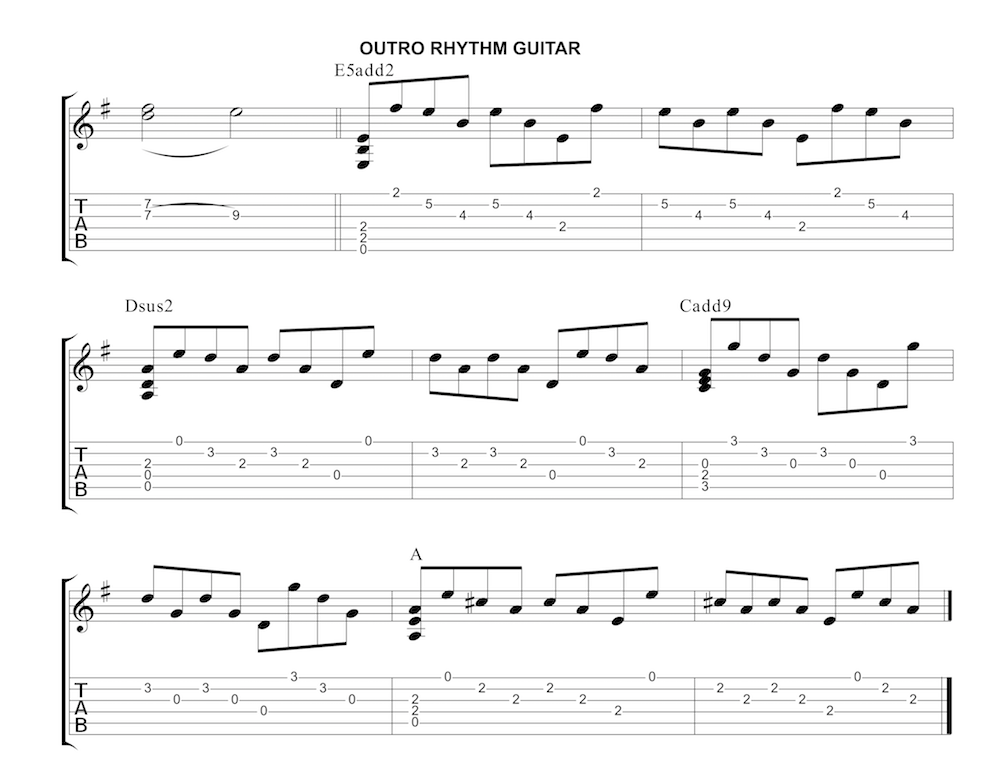
I’ve written out the music and tab below. It’s not perfect, but should steer you in the right direction. Feel free to make changes and adjustments where you see fit. In particular the strumming rhythms can be varied a bit throughout the song. Downloadable PDF version here.


Further Related Lessons

The first Smiths song I looked at on this site was the masterful This Charming Man. More recently I made a video on the beautiful acoustic track Back to the Old House.

Why not also check out the style of one of Johnny Marr’s favourite players, James Williamson, in this lesson on The Stooges Gimme Danger? I’d say this song was possibly at the back of Marr’s mind when he came up with the Headmaster Ritual riff.

Another of Marr’s favourite players is the Pretenders’ James Honeyman-Scott. So maybe check out this lesson on the song Kid. What a guitar solo!


Filed Under: Intermediate Tagged With: Alternative, Indie

Gimme Danger by Iggy & The Stooges

5th March 2017 by Adrian Woodward

I’ve had a few requests for this one, and I’m very happy to be returning to The Stooges with this look at possibly my favourite track on the Raw Power album. 


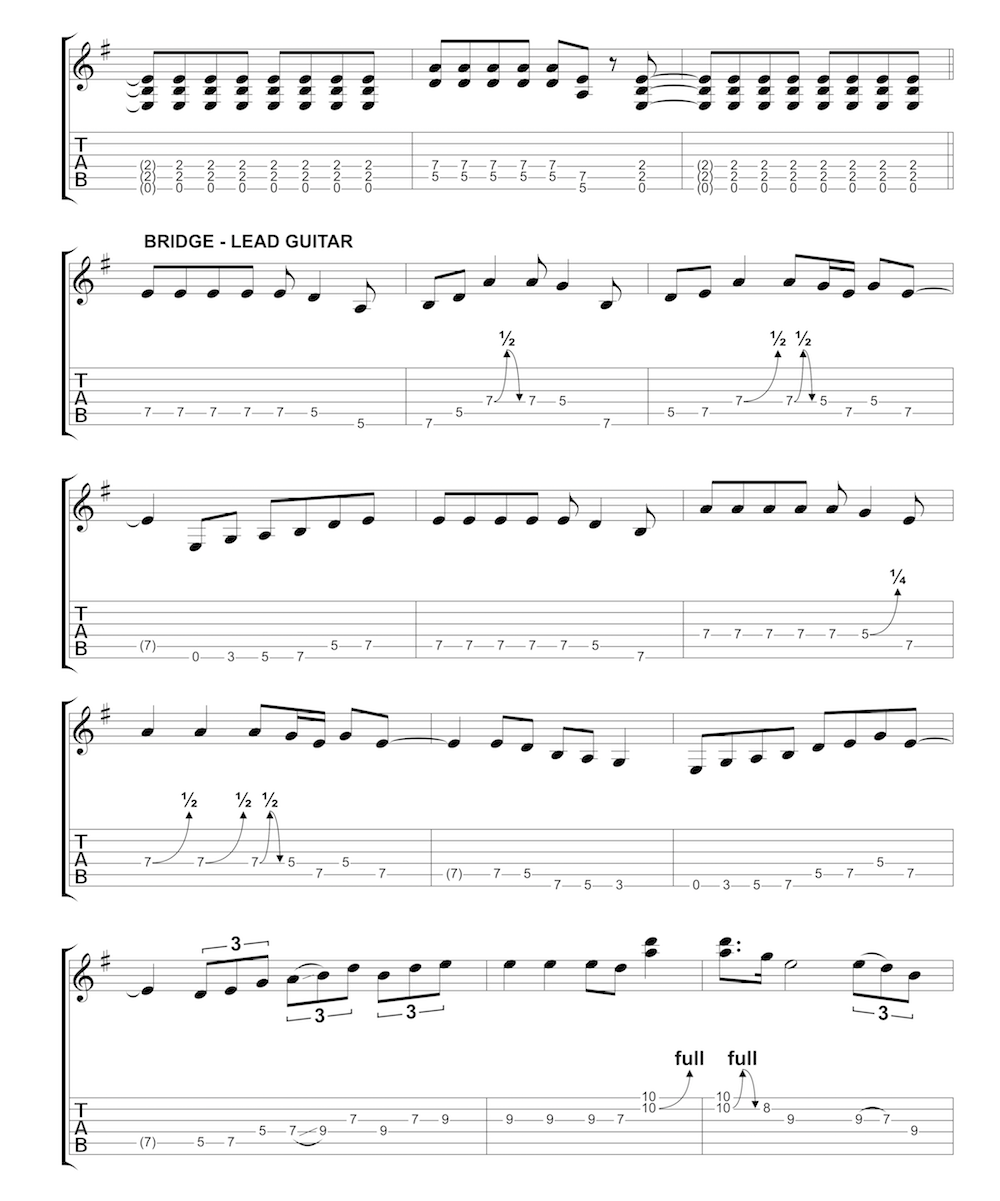
I’ve written out some basic music/tab for all the main sections of the song below. With music like this it’s impossible and probably a bit pointless try and to transcribe everything note-for-note. So use my tab as a guide and, once you’ve got the basic idea, feel free to do things your own way. Want a high-quality PDF? Get it here.

Filed Under: Intermediate Tagged With: Alternative, Punk, Rock

Venus by Television

11th January 2017 by adambradford

The original recording:

Here’s a more recent live video. Good view of Lloyd if you want to see just how he fingers certain licks. These days they play tuned down a semi-tone.

And here’s my transcription. Lloyd is the upper part, Verlaine below. I’ve made a tiny fingering adjustment to how I do it in the video on one of the chorus licks, just to bring it in line with Lloyd’s fingering in the above video. Such is the level of nerdy commitment I bring to these lessons for you! If you want a high-quality PDF of the tab/music, click here.

Filed Under: Advanced, Intermediate Tagged With: Alternative, Punk, Rock

Spellbound by Siouxsie & The Banshees

11th January 2017 by adambradford

by Siouxsie and the Banshees

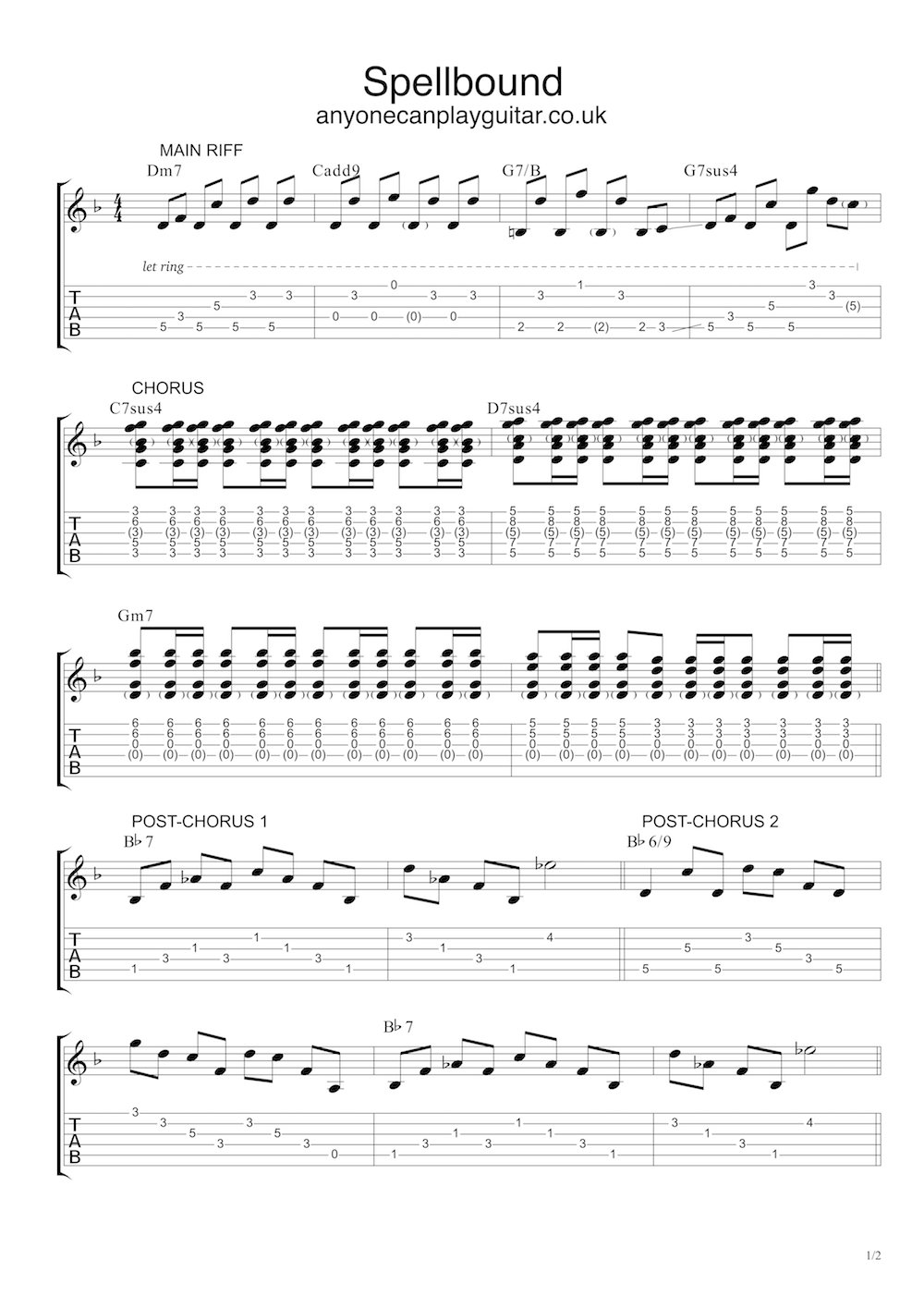
Here’s my follow up lesson to Shot by Both Sides: another classic bit of John McGeoch. It took quite a bit of careful listening and study of various live videos to get to the bottom of exactly how this one is played, but I think I’ve more or less cracked it. I’ve written it out below in the form of the various different riffs which make up the song. Just check out the original recording to hear which bit goes where.


There are a couple of great live performances which are worth watching. I used these to check some of the fingerings and details of exactly how McGeoch does it:

Gear

McGeoch’s sound for this is track is heavily effects-laden – this was the 80s after all. I’m not sure exactly what he would have used on the recording, but I’m guessing it was his main Yamaha SG1000 through a whole ton of processing – chorus and/or flange, reverb, delay, compression…

For this video I plugged straight into my computer for convenience and because I didn’t have all my effects pedals immediately to hand. I used Amplitube for the guitar amp and effects simulation: just a Fender Deluxe amp model, with some chorus, delay and reverb. Then I just played around until it sounded acceptably close to McGeoch’s sound.

McGeoch nerds might be interested in this link, which goes into some detail about exactly what gear he used at various points during his career and includes some great scans of old guitar magazine interviews: http://equipboard.com/pros/john-mcgeoch

Filed Under: Advanced Tagged With: Alternative, Goth, Indie

Purple Rain by Prince

11th January 2017 by adambradford

I’ve always wanted to do a lesson or two on Prince, but up until now it’s been next to impossible since Prince – backed up by a team of hard-assed lawyers – was always super-protective of his music, and refused to allow any unauthorised videos up on YouTube. It’s sad that this situation only seems to be changing after his death, with a large number of Prince-related videos springing up over recent weeks. So I thought I’d go ahead and join them with this look at one of his most famous songs. Fingers-crossed this video will be allowed to remain live.

The original version of Purple Rain apparently started out as a live recording which Prince then took into the studio to work on further. (Some interesting background information on the song here.) How much of the final version is taken from the live gig is hard to say, but it certainly has the energy of a live show. If you hunt around on the internet it’s possible to see footage of the original live performance, with some great close- ups of Wendy Melvoin’s intro and an extended Prince solo at the end.

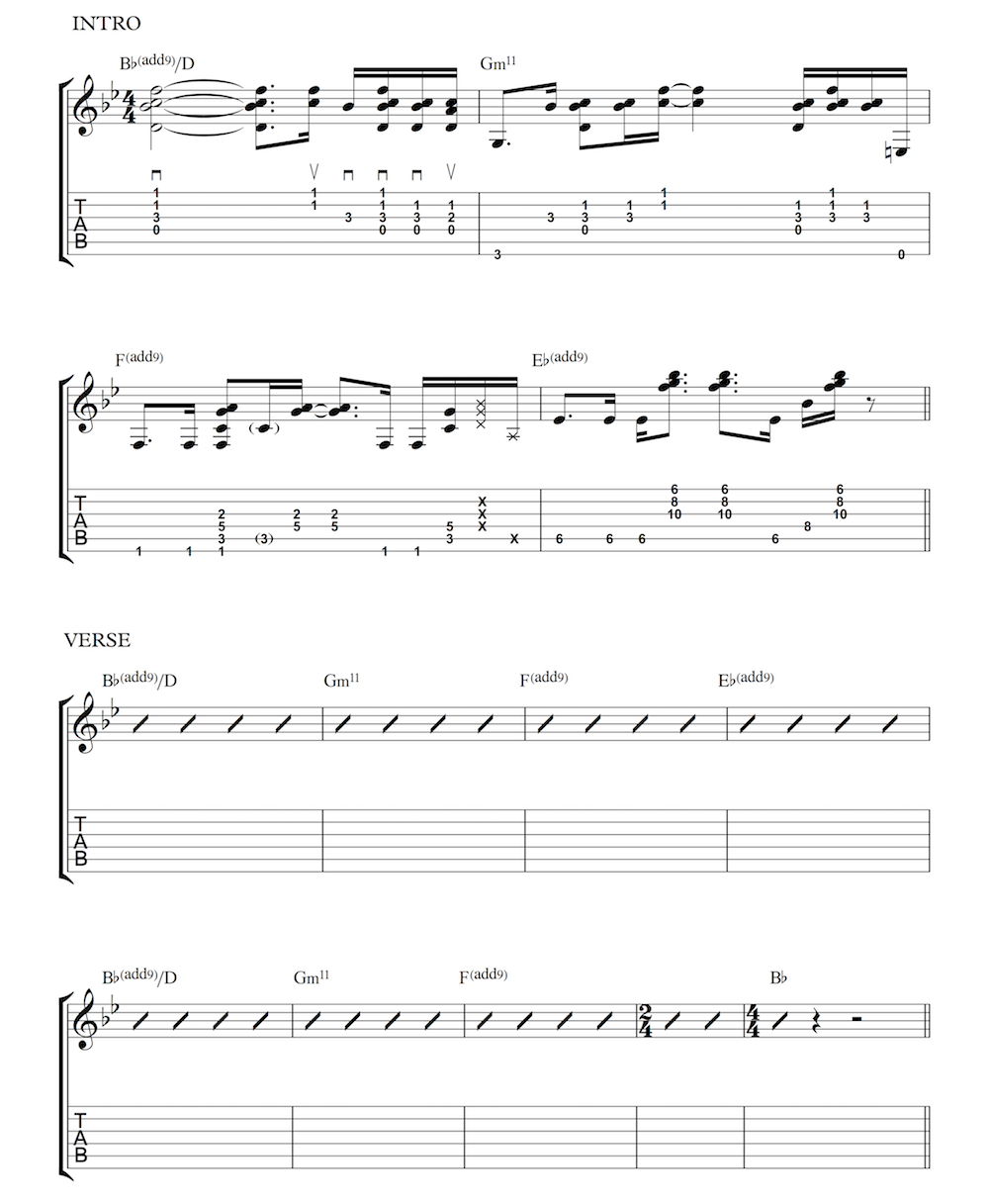
I’ve written out the music below. For the intro I’ve transcribed – as close as I can get to – note-for-note what Wendy Melvoin plays. It looks a bit terrifying when notated like this, but I recommend using this as a guide, concentrating on getting the correct overall feel rather than exactly emulating the recording. Download a high-quality PDF of the music here if you like.

Backing Tracks

For the video I put together a couple of rough and ready backing tracks – one for the intro/verse/chorus, and one for the solo – which I thought I’d share with you here. I’ve looped the solo one a few times so you can really stretch and indulge yourselves to the max. The count-in for the intro is 1 bar (1& 2& 3& 4&) then a hi-hat keeps time during the unaccompanied guitar intro.

Intro/Verse/Chorus Backing:

https://www.anyonecanplayguitar.co.uk/wp-content/uploads/2017/01/Purple-Rain-Intro-Verse-Chorus-Backing-Track.mp3

Solo Backing:

https://www.anyonecanplayguitar.co.uk/wp-content/uploads/2017/01/Purple-Rain-Solo-Backing-Track.mp3

Get The Sound

Going from the live footage, Wendy Melvoin used a Rickenbacker (360?) and Prince his MadCat/Hohner Telecaster. I’ve no idea what they would have been using amp-wise. The intro guitar sound is very dry (possibly recorded direct?) with lots of great 80’s style stereo chorus. For my video, I’m using my Jazzmaster into an 80s Fender Super Champ. For effects I’m using a Boss CE-2 Chorus, and I’m stomping on a 90s Rat distortion for the solo.

Filed Under: Intermediate Tagged With: Pop, Rock

This Charming Man by Johnny Marr/The Smiths

11th January 2017 by adambradford

I’ve been playing and teaching this song for quite a few years now, but I’ve always had the nagging feeling that I wasn’t getting it quite right. For this lesson I was determined to get to the bottom of things, and so off I set on a geeky, sometimes gruelling, odyssey into the heart of Johnny Marr’s amazing guitar playing.

The first issue to be aware of when we’re talking about This Charming Man is that there are actually three different recordings of the song. The track was first recorded for a John Peel session in September 1983, which is the same version that appears on the Hatful of Hollow compilation album. There were two subsequent studio recordings: the “London” version, which to me sounds a little too “produced” with its heavy reverb and effects, and the more muscular sounding “Manchester” version (in fact recorded at Strawberry Studios in Stockport) which was released as a single, and appears on some versions of the self-titled Smiths album. The arrangement and the main guitar part differ slightly between the Peel session version and the other two recordings. I’ve based this lesson on the “Manchester” version, which is probably the most well-known recording.

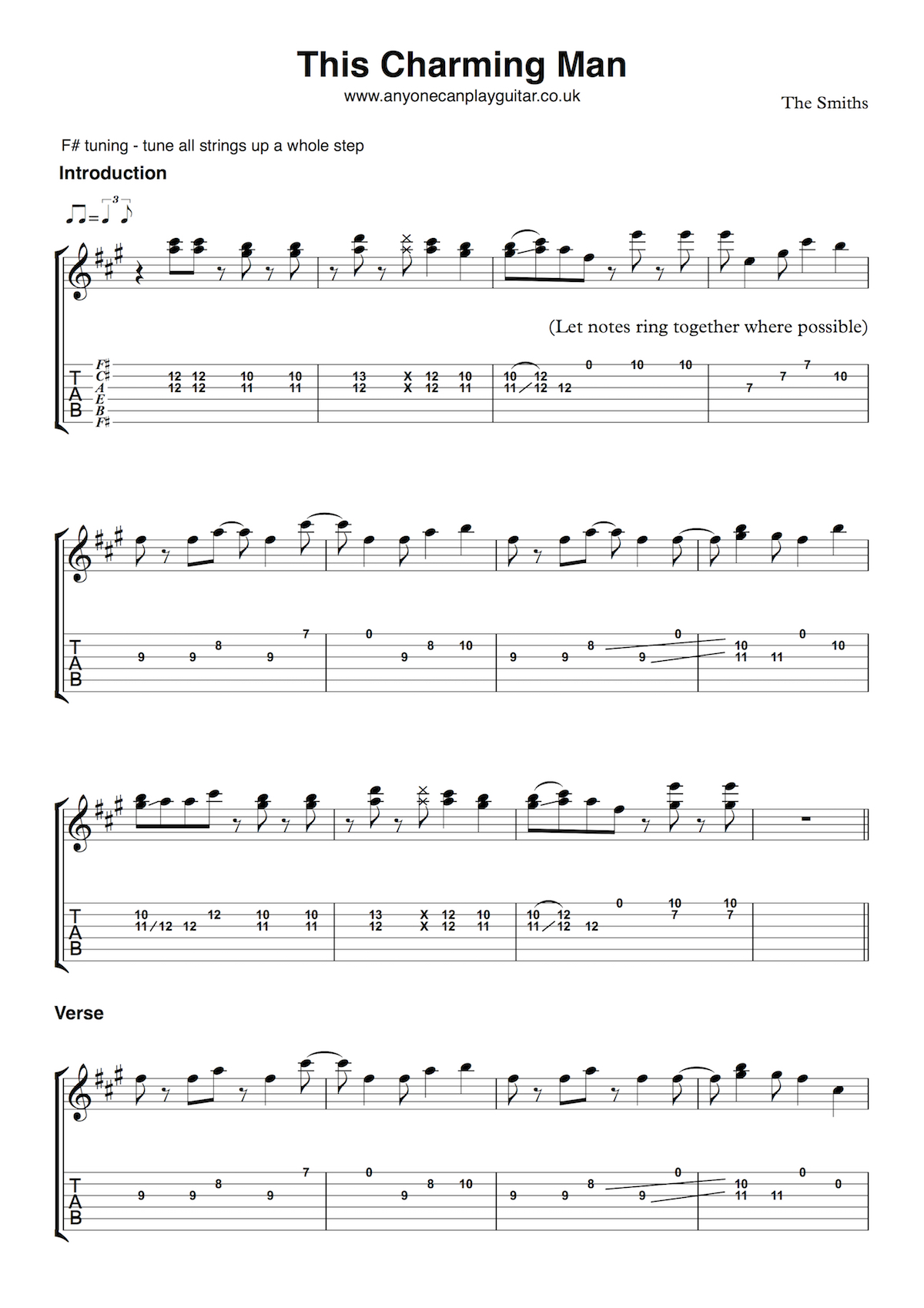
Now that’s cleared up, let’s move on to the actual guitar part. In the past I’ve always assumed that it was played with a capo at the second fret, which was the only way I could get those chiming open string notes to sound correct. It seemed pretty close to me, but just as I was about to film this lesson I thought I’d check out some live Smiths footage just to make sure I was right. Puzzlingly there’s no capo to be seen in any of the old live footage. So the only other possibility was to tune the entire guitar higher. I gave it a try and – voilà – there was that magical sound. I’m not quite sure why (probably some science-y stuff to do with physics and string length) but there’s something about actually tuning your strings up higher which adds a mysterious chime and jangle which a capo doesn’t give you. So if you want to play the song totally authentically you’ll want to tune all your strings up a whole step, so you have (from low to high) F#, B, E, A, C#, F#. (In fact the recording is a bit flat, so the actual pitch is somewhere between F and F#). Disclaimer: I assume no responsibility for any broken strings and/or guitar necks which may result from the use of this tuning. You should be fine on an electric guitar with light-ish strings, but possibly think twice before trying this on your vintage acoustic guitar strung with 15’s. As I explain in the video, I chose to demo the song in standard tuning to keep things simple. The part is exactly as Marr plays it, but it just sounds lower in pitch and doesn’t quite have the same chiming quality.

So we’ve solved the tuning conundrum, now onto the actual playing.When figuring out this particular part, identifying which notes are being played is only half the battle. There’s also the question of which string the note is being played on, and whether a note is fretted or an open string. Part of what makes this guitar part special is its use of open strings to make the notes flow and chime together. With some careful listening I think I managed to get things about 90% correct, but there were still a couple of points where, in a busy mix,  I couldn’t quite hear what was going on. Fortunately, I came across this great video of Johnny Marr playing the song, so I was able to check my version against the way the man himself does it:

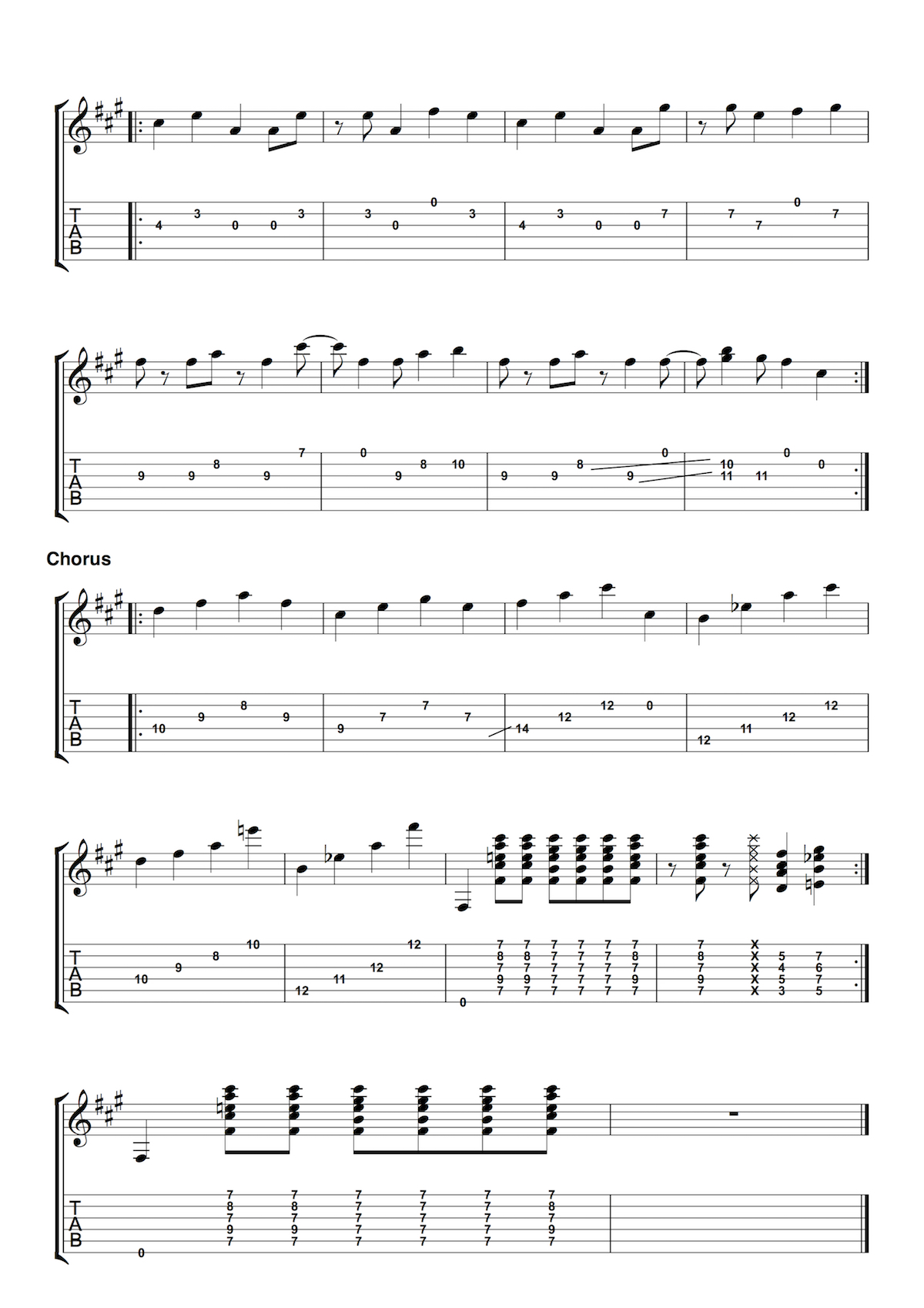
He’s playing in standard tuning, but you can see exactly which strings he’s playing on, where he’s playing open strings, what fingering he’s using, and how he’s picking it. Sadly we don’t get to see him playing the chorus of the song. So for this part I found myself scrutinising ancient Top of the Pops footage, freezing the frame whenever there’s a decent shot of Marr’s fingers just to make sure I got the chords played on the right string sets.

Just as I thought I could go no deeper into Johnny Marr geek-dom, I stumbled across this great article by Joe Gore, who’s an all-round guru when it comes to things indie and alternative guitar-related. It confirmed, amongst other things, that Marr does indeed tune his guitar to F# for this song. You can also hear the isolated guitar stems, not just for the main guitar part but also for the other guitar parts, allowing you to hear details that are impossible to hear in the full mix. There are around 15 – yes, 15! – guitar layers in total. Who would have guessed there’s all this stuff going on? Multiple acoustic guitars, backwards tracks , tremolo, knives…Amazing.

So there we have it. My transcription can be found below, updated to correct a couple of minor slips I made in the video. You can download a high-quality PDF here. Now I just need to get to work on the other 14 guitar parts. And look out for a future lesson on how to play your guitar using knives…

Note on left hand fingering. I perhaps should have gone into this in a bit more depth in the video, as it’s really important to finger this piece in a logical way or it’s difficult to play smoothly up to speed. One spot that can cause problems is the transition from bar 8 to 9. For me the best fingering solution is to play the 10th and 11th fret notes in bar 8 with your 2nd and 3rd fingers, then quickly switch to your 1st and 2nd fingers to play the same notes at the start of bar 9.

More Marr?

Why not check out this lesson I’ve done looking at the more acoustic side of Marr’s style: Back to the Old House


Filed Under: Advanced Tagged With: Alternative, Indie

  • « Go to Previous Page
  • Page 1
  • Page 2
  • Page 3
  • Page 4
  • Page 5
  • Go to Next Page »

Footer Widget Header

Sign up for my monthly newsletter:
  • Home
  • Songs
  • Courses
  • Music
  • Patreon
  • Beginners
  • Blues
  • Country
  • Chords
  • Licks & Solos
  • Resources
  • About
  • Contact
  • Privacy policy
  • Cookie policy

Copyright © 2026 · Anyone Can Play Guitar

  • Home
  • Songs
  • Courses
  • Lessons
    ▼
    • Beginners start here
    • Blues
    • Chords
    • Country
    • Licks & Solos
    • Resources
  • Patreon
  • Music
  • Facebook
  • YouTube
  • Privacy policy
  • Cookie policy