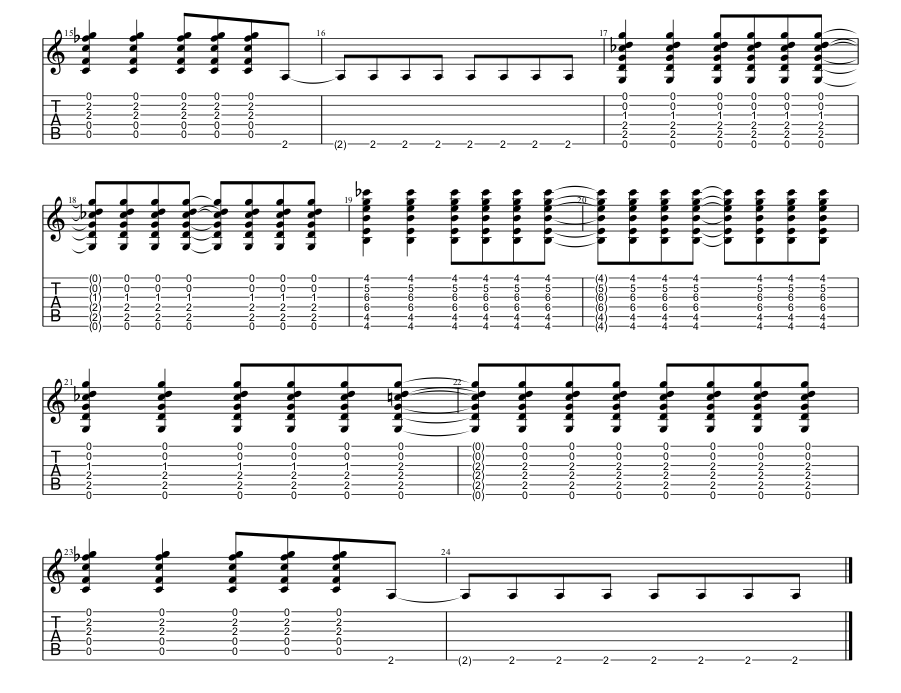
As part of my Les Paul-themed series of lessons here’s my take on a T-Rex classic.
Tab/Backing Track
..is on my Patreon page, as well as my full baking track.
Online and private guitar tuition
As part of my Les Paul-themed series of lessons here’s my take on a T-Rex classic.
..is on my Patreon page, as well as my full baking track.
I’ve written out the riffs for this song below. Tab for the solo can be found on my Patreon page.

An all-time rockabilly classic, this one. The solo – played by Nashville session ace Grady Martin – is particularly stunning. If you’ve not heard the original song, check it out here (the video below seems to be a mimed performance, with Paul Burlison on guitar.) Also, the entire Rock n Roll Trio album is essential listening and a very influential record – Clapton, Page and Beck were all fans.
Here’s my video:
I’ve written out the intro lick and the complete solo below. For a PDF of the tab which also includes the verse/ending parts as well as an MP3 file of my backing track please sign up to my Patreon page.


Then check out this lesson I did a while back on Elvis’ Mystery Train.
Other rockabilly lessons you might enjoy:
Gene Vincent’s Race With The Devil.
Diminished Scale Rockabilly Lick
This 1978 track from the Only Ones has to be one of the greatest rock songs of the ’70s. It contains plenty of memorable guitar playing, from Peter Perrett and lead guitarist John Perry.
I’ve written out the first bit of the intro rhythm guitar and the intro guitar solo below. On the original recording the solo is double tracked with each guitar playing slightly differently. So my transcription is kind of an average of both parts. It’s all based on the E major pentatonic and E major scales.


If there’s overwhelming demand for it I’ll write out the main guitar solo too. Let me know if you’d find that helpful.
Check out this live performance from the VU reunion in 1993. Can clearly see Lou playing it in G but, frustratingly, there’s not a single shot of Sterling Morisson.
In this lesson I’m looking at Sterling Morisson’s lead guitar parts and solo from this Velvet’s classic from 1969. (For Part 1, looking at Lou Reed’s easy to play rhythm part, click here.)Nothing too challenging technically here, just some memorable, beautiful playing. I’ve written it all out for you below. I haven’t gone to the trouble of writing out all the verses and choruses since, bar the odd minor variation, they’re all the same. Download the music/tab here.


Here’s my definitive, 3 part look at how to play the Chuck Berry classic Johnny B Goode.
So I’ve finally got round to looking at a bona fide guitar classic. It’s one of those songs that everybody seems to play slightly differently (that includes Chuck himself who in the live performances I’ve checked out never seems to play it the same way twice). So what I’ve done is gone back to the original recording, to try and get the definitive answer to how it should be played. As an exercise I think it’s fun to try and get as close as possible to how Chuck plays it here, but really it’s up to you how far you want to take it. Probably the most important thing is to play with a bit of style and attitude, and not to worry too much about every last detail of the original.
Notice how the original recording is made up of two different guitar performances. It sounds to me like there’s one continuous guitar part, probably laid down by Chuck live with the band, and then there’s another overdubbed layer of lead guitar which comes in and out at various points during the song. The intro is in fact made up of two different guitar tracks: the first four bars are the original live guitar take, then the overdubbed lead guitar takes over as the band kicks in, and the other guitar switches to playing rhythm. I’m combining both the lead guitar parts into one here.
In Part 2 I looking at all the rhythm guitar parts, together with a few of the lead guitar fills. As I mentioned in the first lesson, the original recording is made up of two separate guitar performances. There’s the continuous live guitar take which is made up of mainly rhythm chords, and then there are the lead guitar overdubs which you can hear in the second half of the intro, during the choruses and in the solo. If you’re playing with another guitarist you could split the two parts between the two you, but if you’re playing on your own why not try combing the two parts into one?
The basic rhythm guitar part is pretty straightforward: a blues in Bb played entirely using a bass note boogie type pattern. This just stays the same throughout the song. It’s just the introduction which is slightly different. For the choruses I’ve combined the lead and rhythm parts into one. Each of the three choruses has a slightly different lead guitar part.
For the 3rd and final lesson in my JBG series I looking at the guitar solo. As with the intro, the solo is made up of two different guitar tracks which I’ve combined into one. The first 4 bars of the solo are the main live guitar part, then the overdubbed lead guitar takes over until the end of the 12 bar chorus. And it’s the same pattern during the second half of the solo.
If you’ve come this far it would seem silly not to try and play the whole song from start to finish. It’s really just a matter of getting used to the structure and piecing together all the parts we’ve looked at so far. To help you with his I’ve put together a PDF with the music/tab for the entire song as you might play it as a single guitar performance. Complete Song PDF.
You could practice this by playing along to the original recording, to a backing track or by playing with real human beings if you have any to hand.